After Michele and Richard had both retired (Michele in 2010 after a 30 year education career, and Richard in 2024 after a 42 year medical career) and our daughter Shauna’s home was finished, in February 2025, we were ready to take on another RavenRidge Family Farm adventure.
Soon after we started practicing Regenerative Farming, we read a book by Douglas Tallamy “Nature’s Best Hope: A New Approach to Conservation That Starts in Your Yard”.
He discussed the critical role of native plants as foundational to a healthy ecosystem, and suggested what he called at the time the “Backyard National Park” as a solution to the dramatic decline in ecosystem health he was seeing in his research as chair of Entomology and Wildlife Ecology at the University of Delaware.
The book resonated with our evolving Regenerative Farming approach to the land and we began implementing his recommendations at small scale.
With time on our hands after retiring, we were ready to scale up Dr. Tallamy’s proposed solution.
Since writing that book, Dr. Tallamy co-founded the not for profit organization Homegrown National Park.
In May 2025, we joined the initiative.
Getting Started on the Journey
The Homegrown National Park (HNP) principles are to remove Invasive Plants and plant Keystones and Beneficials native to your ecoregion.
Following are their links to resources related to each category of plant:
- Remove invasives
- Include Keystone plants native to your EPA Level II ecoregion
- Plant additional Beneficial plants local to your ecoregion
In addition to HNP’s plant lists, we found the following resources to be useful here in North Carolina:
- Xerces Society’s Polinator Plant Lists
- North Carolina Native Plant Society’s Invasive Plant List
- NC State’s Extension Gardener Plant Toolbox
To facilitate our activities, we developed a database that aggregates plant data from all these resources.
Documenting and Displaying the Data
Due to the size of our property, we needed to have an efficient way for multiple people to document the geolocation of Invasive, Keystone, and Beneficial plants.
After much trial and error, we settled on these apps:
- Seek by iNaturalist to identify plants
- GPS Logger to mark the geolocation of plants and save as a KML file
- Google Earth to display data on mobile devices
- Google Earth Pro the desktop only version with advanced functions not supported by Google Earth
Dividing the Property into Areas
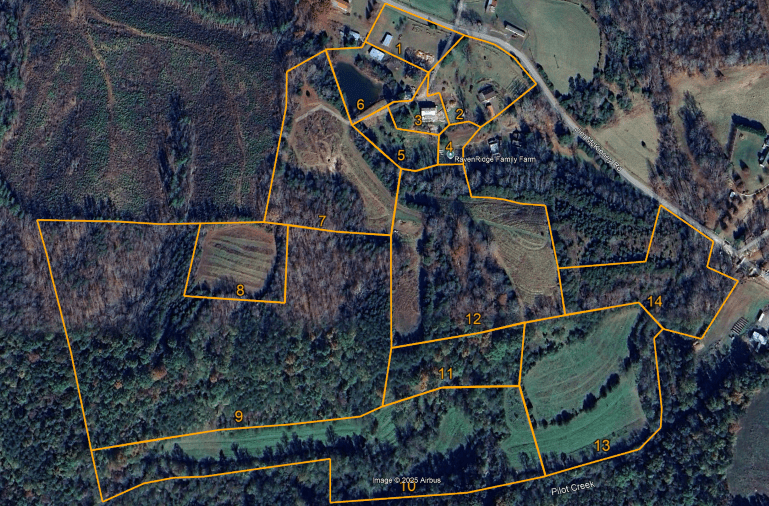
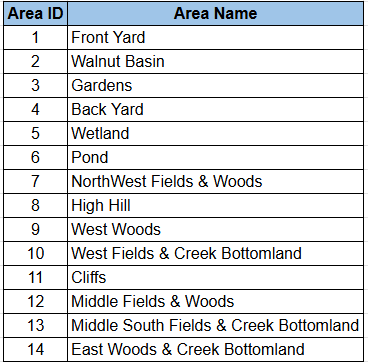
We divided the property into areas, based on terrain and microclimates, to help us focus our efforts and prioritize our activities.
RRFF Areas
RRFF Areas Key
RRFF Current Focus
Consistent with HNP’s principals, our primary Homegrown National Park (HNP) objectives for the next 3 years are to eliminate the Invasives; support the Keystone and Beneficials currently on the property; add Keystones in areas that are deficient; and begin to convert some of our current lawn area into native plant landscapes.
 RavenRidge Family Farm