Our Homegrown National Park (HNP) remediation focus for 2025 is to begin removing the Invasive plants.
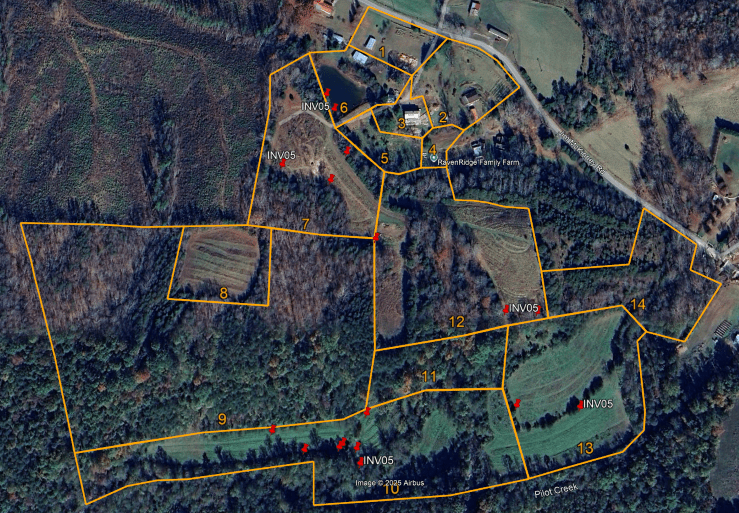
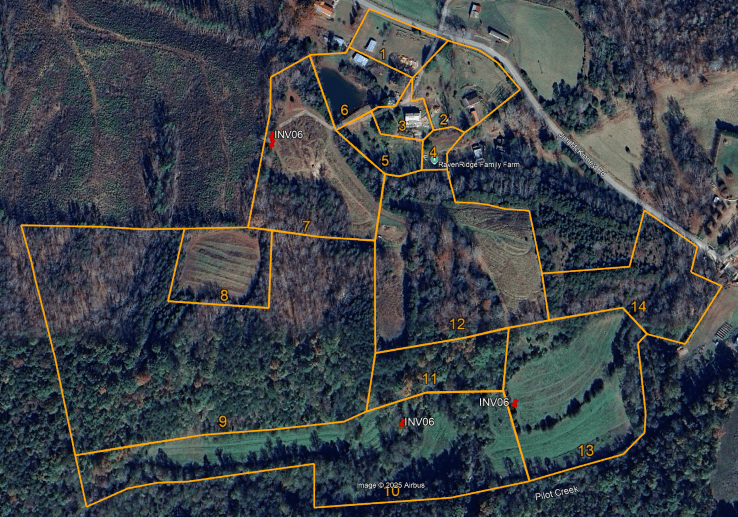
The following Google Earth Pro images show the location of each of the Invasive species identified in our survey, by area. This level of detail was essential for developing the 2025 Invasives Remediation Plan.
INV01_Lespedeza cuneata (Chinese Bushclover)
The fields in Area 8 and 10 are 80- 90% Lespedeza cuneata. The other fields have scattered patches.

Picture of Lespedeza cuneta in Area 10 west (long bottom) field

INV02_Lespedeza bicolor (Shrubby Lespedeza)
The middle field in Area 10 is 60% Lespedeza bicolor. The north field in Area 13 has scattered patches.

Picture of Lespedeza bicolor in the middle field of Area 10

INV03_Ligustrum sinense (Chinese Privet)
There are concentrated areas of Ligustrum sinense along the forest edges in Areas 7, 10, and 13.

INV04_Pyrus calleryana (Bradford Pear).
Pyrus calleryana are concentrated in Areas 12 and 13. We expect there will be large populations in Area 14 as well when we survey the forests later in 2025.

INV05_Rosa Multiflora (Multifloral Rose)
Rosa Multiflora are concentrated in Areas 7 and 10.
INV06_Albizia julibrissin (Mimosa)
There are very few Albrizia julibrissin on the property.
INV07_Lonicera japonica (Honeysuckle)
Most of the Lonicera japonica is in Area 10.

INV08_Microstegium vimineum (Japanese Stilt-grass)
The field below the cliffs in Area 10 is 70% Microstegium vimineum. It is scattered along the forest edges in other areas.

Picture of Microstegium vimineum in the Area 10 field below the cliffs.

INV09_Elaeagnus umbellata (Autumn Olive)
Elaeagnus umbellata is concentrated around the forest edge of Area 12, with one large tree in the corner of the southeast field. This is a tree our family has harvested fruits from in the past. It’s a necessary sacrifice, but will be missed.

 RavenRidge Family Farm